
In Memory of Christopher C. F. Naylor
Kit Naylor (1929–2026)
The Society was deeply saddened to learn of the death of Christopher Charles Francis Naylor, known to all as Kit. He was a long-standing and devoted member of the Society and its Council, serving as Honorary Treasurer (2000-2006) and Vice-President (2006-2009).
Kit was an exceptionally strategic Treasurer. He fully understood and supported the purposes of the Society and skillfully sought to ensure it operated on a sound financial basis. He was instrumental in planning and overseeing the sale of the Society’s former premises at Queen’s Gardens and in the purchase, refurbishment, and eventual relocation to Stephenson Way. As a descendant of Henry Thomas Colebrooke, the founder of the Royal Asiatic Society, Kit’s devotion to the Society was both personal and profound. During his time as Honorary Treasurer, he visited frequently—often two or three times a week—and gave unstintingly of his time, judgment, and energy.
He made available the Colebrooke papers and extended generous hospitality to Professors Ludo and Rosane Rocher while they wrote The Making of Western Indology: Henry Thomas Colebrooke and The East India Company which was published by Routledge in collaboration with the Society in 2011. His wisdom, courtesy, and gentle but perceptive sense of humour were greatly appreciated by all who worked with him.
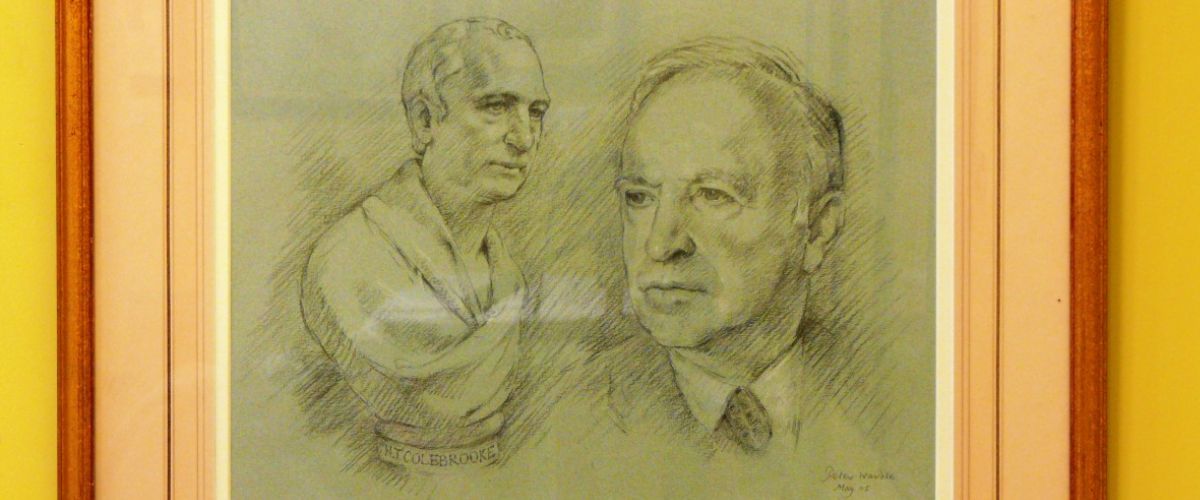
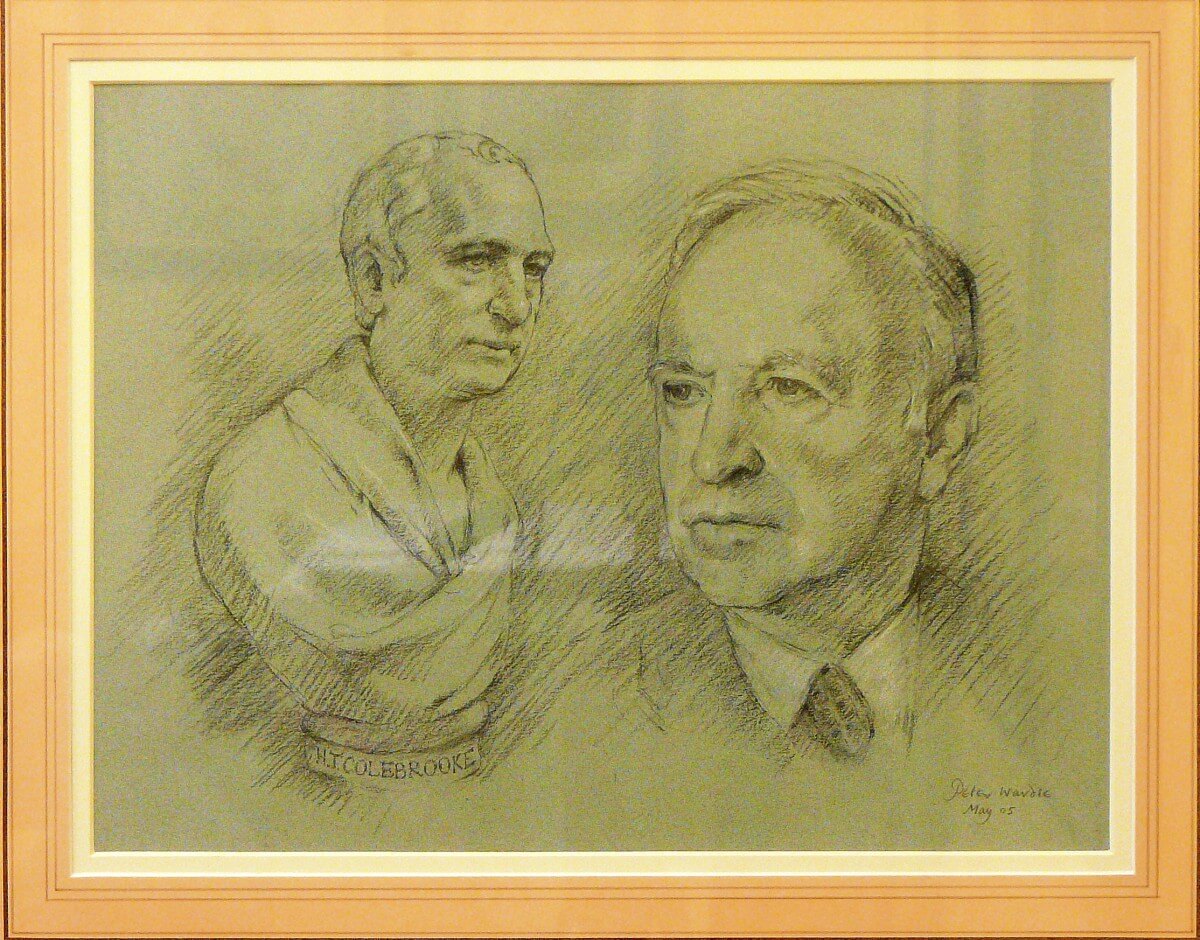
In recognition of his exceptional service and commitment, Professor Robinson and the Council commissioned a drawing of Kit alongside the bust of his ancestor Henry Thomas Colebrooke. This now hangs in the Society’s lecture room as a lasting tribute.
Alison Ohta
Kit’s funeral was held on the 19th of January at St Margaret’s Church, Ridge. The following is an abridged version of the eulogy delivered by his son, Thomas Naylor.
—
My father was not one for grandstanding, so I’m not sure what he would have thought of this. The only time I ever heard him give a speech was at my sister Francesca’s wedding—and it was perfect, as though he had been delivering speeches all his life.
Kit was born on 23 March 1929 at 5 St James’s Square, or, as he was fond to mention, the building that later became the Libyan Embassy. It took three days for news of his birth to reach his father, Frank (Major-General Robert Francis Brydges Naylor, CB, CBE, DSO, MC, 1889-1971), who was serving with the West African Frontier Force in Nigeria at the time.
Wrotham Park near Barnet was his main home growing up. His father’s career in the army meant a peripatetic life, and Wrotham provided a stable home for Kit with an extended and loving family in holidays, and during the war, while his father was stationed in London and, later, in 1944 to 45, in North-West Europe.
Kit’s first school was Hawtrey, in Shropshire, safe from the bombs of WWII and nearer to his father, then based in Chester. There, once, with his siblings he arranged the chucking of mud balls at passers-by from behind a wall: the occasion of a major ticking off. It was not how the children of the General were supposed to behave!
From Hawtrey he went on to Eton, where, not being overly keen on cricket, or indeed rowing, he was a founder of the first tennis team. Academically very bright, history was his favourite subject.
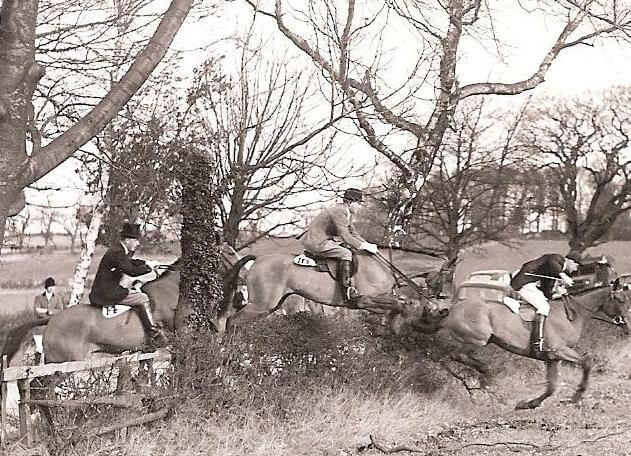
Following Eton, Kit went to Sandhurst and joined the 12th Royal Lancers. Kit’s true passion was horsemanship. While stationed in Germany, riding his aunt’s horse, ‘Lazy Legs’, he won a major race, to the pride—and surprise—of his fellow officers.
He was later posted to Malaya. His diary records a life of night ambushes, escorts, and fleeting visits to Penang. Although he spoke little of this period, he once told me that he had led over 200 food escorts. Logistics though, particularly during the rainy season, were far from easy. Relations with his commanding officers were not always cordial. On one occasion, while speaking on the telephone, the box he was in was struck by lightning. Kit was thrown to the ground. He got up, went to the dangling phone. His commanding officer was still on the line. “What are you doing!?” he demanded. “I’ve just been struck by lightning,” Kit replied. The response: “Serves you bloody well right!”
Finding the outward troop-ship journey to Malaya intolerably dull, Kit and his friend Peter Gerrard decided instead to drive back to England. They bought a 1952 Ford Ranch Wagon, shipped it from Penang to Calcutta, and from there drove all the way back to London. The adventure almost came to a premature end, when, en-route through India, my father visited relatives in a tea plantation close to Shimla. He was a day late. But the coronation chicken that had been prepared was kept for that second day. And as a result, Kit got very ill indeed. His hosts were nervous as to whether their visitor would survive.
Meanwhile on the other side of the world, Kit’s sister Molly, while working for six months in America, met a new friend, Helen, in New York. A few months later when Helen was visiting Molly at the family home, Kit turned up, unexpected, on leave. They were destined to be together. After spending time in London, and New York together, Kit and Helen were married in Tuxedo Park, New York State in 1959.
After leaving the army, Kit joined Marconi Avionics, later part of GEC, where he spent over thirty years. He particularly enjoyed trade missions to China. A colleague later described him as “the best and cleverest boss I ever worked for—never really a boss, always a friend.”
In retirement, Kit was looking what to do – his interest in his ancestors, especially Henry Thomas Colebrooke, led him to the Royal Asiatic Society, where he served as Treasurer, Vice-President, and Council member. He played a key role in securing its move to Stephenson Way, close to the British Library and SOAS. In the lecture hall there now stands a bust of Colebrooke, bearing more than a passing resemblance to Kit himself.
Alison Ohta, Director of the Society, observed: “Kit was absolutely devoted to the Royal Asiatic Society. He was observant, fair, perceptive, and had a wonderful sense of humour.”
Above all, my father was defined by kindness. A devoted bird- and butterfly-watcher, he loved nothing more than a good walk. When I hear a wood-pecker knocking, a wood pigeon coo, when I see the fledgling swallows taking flight, I will think of my father.
Thomas Naylor
—
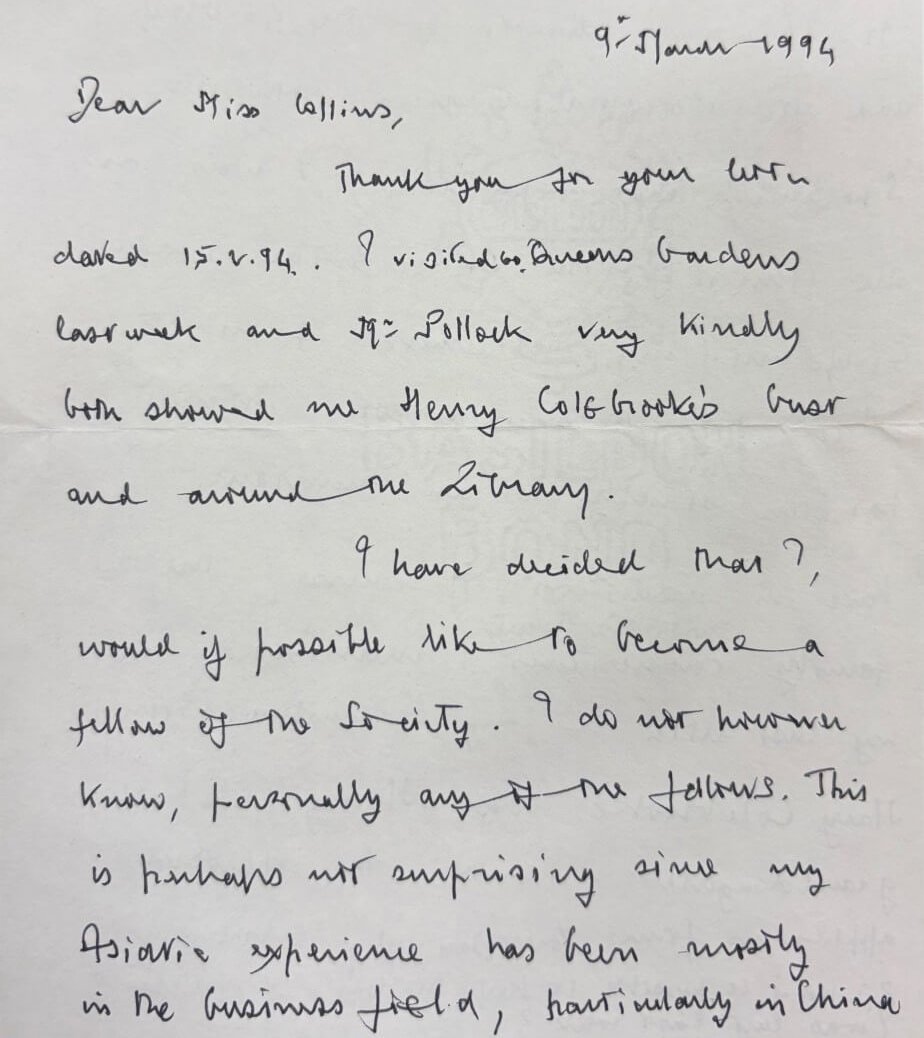
In our Archive, we hold a letter written by Kit documenting his first encounter with the Society: ‘I visited 60 Queen’s Gardens and Mr Pollock very kindly both showed me Henry Colebrooke’s bust and around the Library. I have decided that I would if possible like to become a fellow of the Society…’
Talks and Events
Yesterday evening, Thursday 22 January 2026, the Society’s Bayly Prize ceremony took place, featuring presentations from the 2024 prize winners: Dr Luis Junqueira, Dr Xiaoqing Wang, and Dr Junda Lu, who joined online. More information of the prize winners and their research can be found in our previous blogpost here.
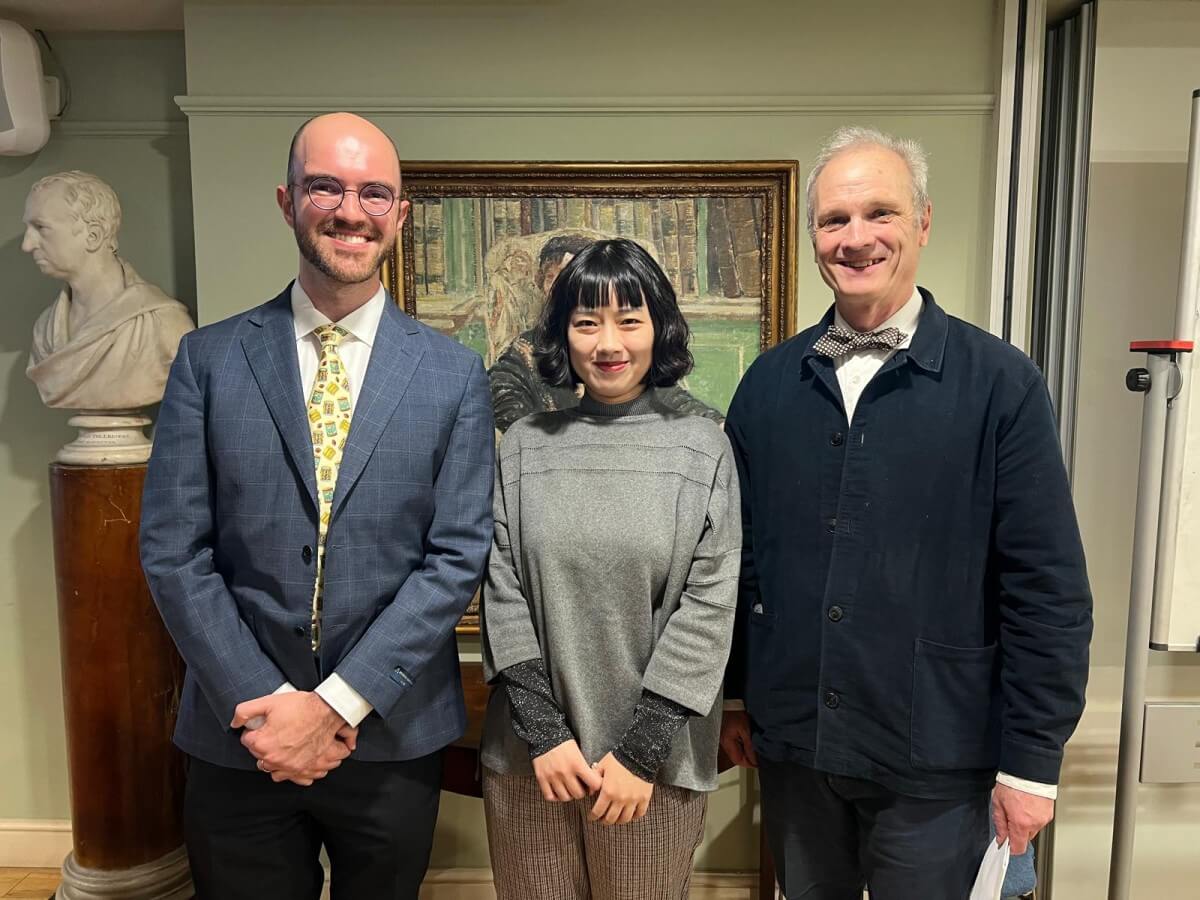
The Society’s President, Dr Norbert Peabody, has observed that the Bayly Prize provides a glimpse of future scholarly directions, and that the presence of three excellent theses on modern China points to changing patterns of research within Asian studies in Britain and Ireland.
We are very grateful to the presenters and the prize jury, and we hope that all who attended enjoyed the evening.
In other news, this coming Monday 26 January at 7.30pm, the Society’s librarian, Dr Edward Weech, will give an online talk for the American Society of Church History’s Working Group on British Nonconformity in the Long Eighteenth Century. Titled ‘Thomas Manning, Nonconformism, and the Early British Encounter with China’, the talk will explore how Manning’s religious milieu helped shape the moral and imaginative orientation that predisposed him to seek alternative civilizational models outside the Anglican and imperial mainstream. If you would like to attend the talk, please email Edward at ew@royalasiaticsociety.org.
James Liu and Edward Weech