Georgios C. Liakopoulos
Gingko, 2019
ISBN: 9781909942325
Published by the Ibrahim Pasha of Egypt Fund
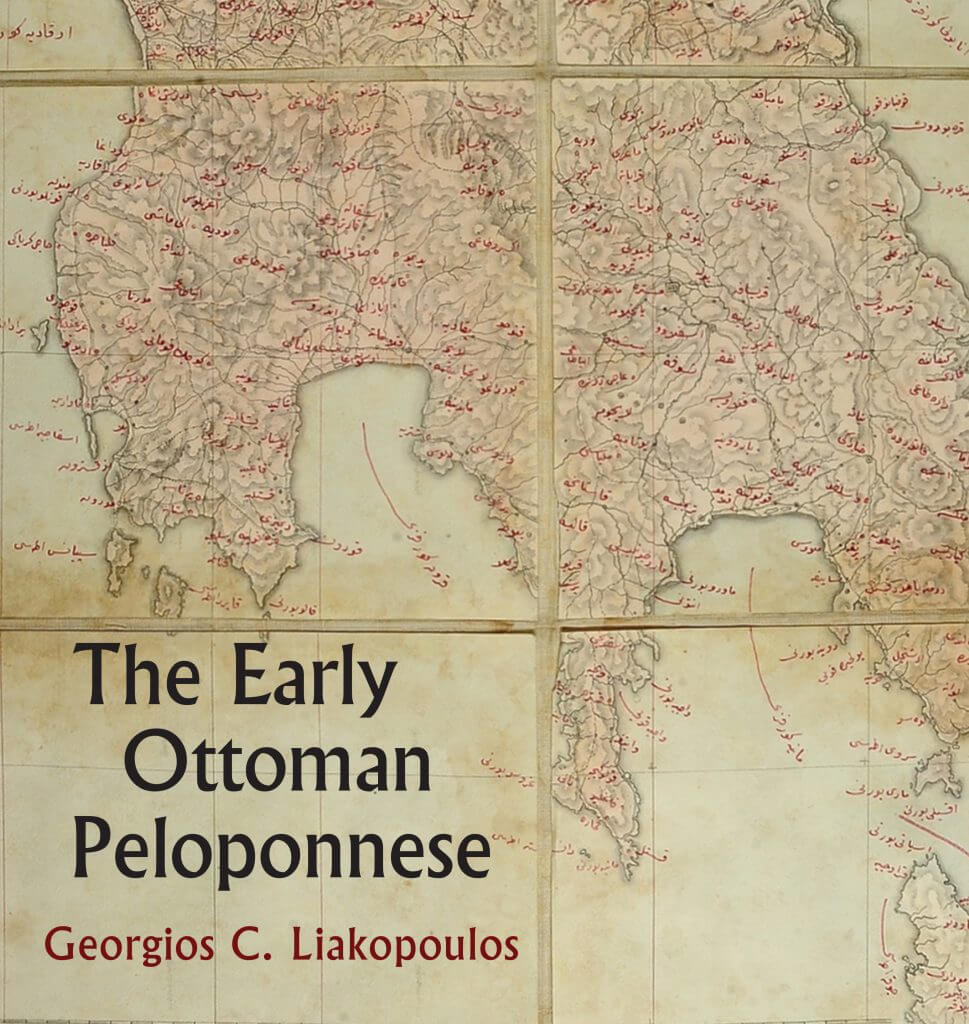
In this book, Georgios C. Liakopoulos presents a unique insight into late Byzantine Peloponnese society and its economy, and how these were incorporated into the Ottoman Empire, using as reference the cadastre compiled immediately after the Ottoman conquest. What makes this study imperative is the fact that no similar Byzantine document of the period has survived. The author offers a thorough analysis of the demography of the Peloponnese and its categorisation into urban/rural and sedentary/nomadic, concentrating on the Albanians, the second largest ethnic group after the Greeks. A detailed presentation of the level of agricultural production, livestock, fishing and commerce is illustrated with tables and charts. The book is complemented with a diplomatic edition of the transcribed Ottoman text and facsimiles of the cadastre.
The volume ‘The Early Ottoman Peloponnese: A study in the Light of an Annotated editio princeps of the TT10-1/14662 Ottoman Taxation Cadastre (ca. 1460-1463)’ is a revised version of the author’s PhD thesis, conducted at Royal Holloway, University of London, under the supervision of the late Professor Julian Chrysostomides. Part I contains an Introduction, three Chapters (1-3) and a Conclusion. The Introduction presents the aims, scope and methodology adopted, followed by a survey of previous scholarship conducted on the subject, and a brief historical examination of the late Byzantine Peloponnese and its conquest by the Ottomans. It concludes with a brief codicological and palaeographical description and dating of the cadastre TT10-1/14662. Chapter 1 presents the Historical Geography of the Peloponnese, listing all the place-names (667 in total) mentioned in the sequence they appear in the TT10-1/14662 register accompanied by topographic and linguistic notes. This is followed by a set of thirty-eight digital maps of the early Ottoman Peloponnese using GIS (Geographical Information Systems). Chapter 2 discusses the Demography of the Peloponnese, including the settlement patterns, the density of population and its categorisation into urban/rural, sedentary/nomadic, concentrating, in particular, on the influx and settlement of the second largest ethnic group, after the Greeks, in the peninsula, namely the Albanians.Chapter 3 explores the Administrative and Economic Structures of the Peloponnese, concentrating on the Ottoman timar system and taxation. A detailed presentation of the level of agricultural production, types of crops, livestock, fishing, commerce, industrial development, etc. is illustrated with tables and charts.The Conclusion summarises the findings of the research and attempts to identify areas for possible future investigation. Part II comprises a diplomatic edition of the transcribed Ottoman text. The study closes with full bibliography followed by facsimiles of the cadastre.
Available for purchase at the discounted rate of £25 with free shipping to the UK via the Gingko Website