
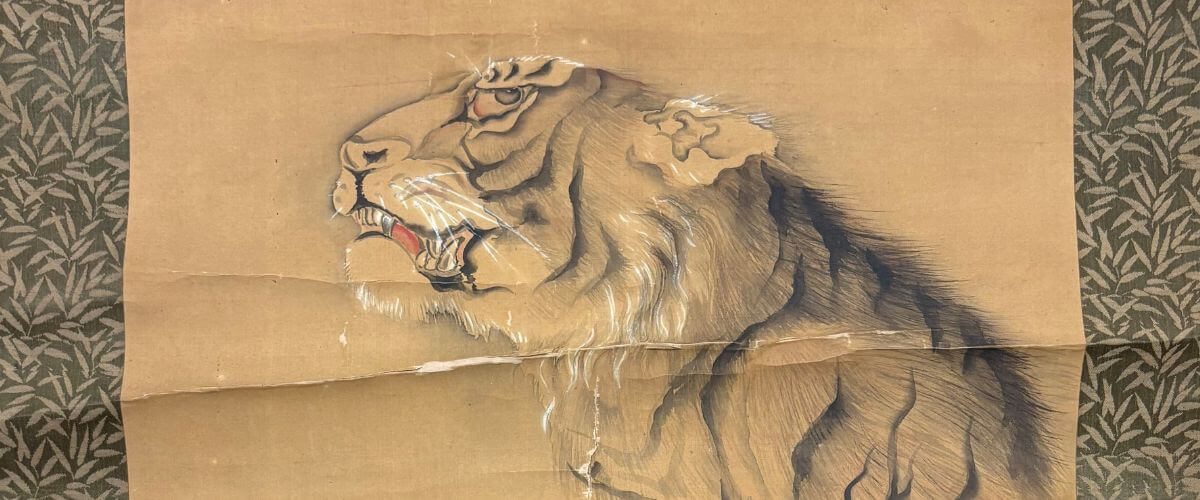
Maruyama Okyo’s Fierce Tiger
The Society has had an lively and eventful week. On Monday 9 February, we were delighted to welcome Professor Agus Suwignyo from Gadjah Mada University, Indonesia. His lecture traced the evolution of environmental discourse and activism within the Indonesian Catholic community from the 1950s through the 1990s, offering a fascinating window into the intersection of faith, politics and ecological awareness.
Yesterday, 12 February, we hosted Joy Hendry, Professor Emerita at Oxford Brookes University, who reflected on the 50th anniversary of her first fieldwork trip to Japan. Her talk blended personal insight with scholarly reflection, making it a memorable contribution to our ongoing Japanese Studies lecture series. This series continues over the coming months and will conclude in May with Professor Simon Kaner’s lecture entitled Towards 150 Years of Japanese Archaeology and Its Broader Asian Connections, which will also serve as the Society’s Anniversary General Meeting lecture.
Recordings of our previous lectures including those of this series are available on our YouTube channel. The most recent upload features Dr Christopher Harding discussing the first century of encounters between Japan and Europe – the lecture was one of our most well-attended recently and continues to attract viewers. If you missed it, we highly recommend catching up here: https://www.youtube.com/watch?v=–DAX7ANTb0
––
And speaking of Japanese Studies, I thought I might share a small but delightful discovery from this week. It emerged as part of our team’s ongoing work to catalogue unprocessed artworks in the collection. The batch I was working through consisted mainly of Chinese scroll paintings, including one intriguing item stored in a wooden box. I was led to believe that the content was another Chinese scroll painting for two reasons: first, it was housed alongside other Chinese scrolls (more on this in a future blogpost!) and second, the wooden box carried a modern label reading ‘Dr Duncanson Chinese Scroll’.
When I opened the box and unrolled the scroll, a seated tiger revealed itself – its face lightly coloured with white strokes that emphasise its whiskers. The expression is fierce yet composed, and the overall posture radiates a quiet strength.

The painting is untitled and undated, but it does bear the artist’s seal in the lower right corner. Fortunately, there is also an inscription on the reverse, written in Chinese characters: 猛虎 應舉真蹟最珍品. The inscription was enough to give me a few promising leads. After some digging, I was able to attribute the seal not to a Chinese, but Japanese artist – the Edo‑period Japanese artist Maruyama Okyo 円山応挙 (1733–95). Okyo was active in 18th‑century Kyoto and became renowned for his naturalistic style, particularly his remarkably lifelike depictions of figures, animals and landscapes. His works are held in major institutions worldwide, including the Metropolitan Museum of Art and the British Museum. In the British Museum there is another scroll painting of a tiger – equally fierce, though captured in a crouching pose – that echoes the spirit of the piece I found.
From what I’ve read, Okyo’s tiger paintings are particularly intriguing. As an artist celebrated for sketching directly from life, he faced an obvious challenge: tigers were not native to Japan and therefore unavailable for direct observation. Okyo allegedly relied on domestic cats as stand‑ins when depicting tigers, which may explain why his tigers often have large, rounded eyes, just like the one in our painting.
Returning to our scroll: although the inscription describes it as ‘A Fierce Tiger’ and even claims it to be ‘the best of Okyo’s authentic works’, the only concrete link to the artist is the seal. An online seal‑search database includes a comparable example attributed to Okyo, dated to when he was 48 years old – around 1781 – which may offer a tentative timeframe for our painting. However, this seal is not accompanied by any signature like many other works by Okyo that I can find online, so it is difficult to establish the connection for sure.

If anyone is able to identify the seal more precisely, or has expertise in Okyo’s art and can shed further light on this work, I would be delighted to hear from you.
In terms of provenance, I haven’t yet been able to trace the painting’s full history. However, if the label on the wooden box has at least some truth to it, the scroll may have entered our collections through Dennis Duncanson (1917–98), the Society’s former President and Director during the 1980s and 1990s. Duncanson specialised in Chinese and Vietnamese studies, so it’s fascinating to learn that he might have an interest in Japanese art as well.
––
Before wrapping up this blog post, a quick reminder about our next lecture, which offers a brief pause from our Japanese series. On 26 February, we will welcome Dr Paul Wordsworth, Lecturer in Silk Roads Archaeology and Heritage at UCL. Dr Wordsworth will discuss some of the challenges that emerged from his research on the archaeology of the Karakum Desert in Turkmenistan, shedding light on what lies ahead for understanding historical trade and travel across Central Asia. More details can be found here.
As always, everyone is welcome. If you would like to attend online, please email mb@royalasiaticsociety.org to receive the link.
James Liu